ICube API φ-FEM (2022-2023)
Title
Implementing the φ-FEM immersed boundary finite element method in the open-source Feel++ library, with applications to biomechanics
Principal investigator
Michel Duprez
Funding
Internal call for proposals (API) of the ICube laboratory, 2022
Budget
€10k (€5.2k in the first year, €4.8k in the second)
Abstract
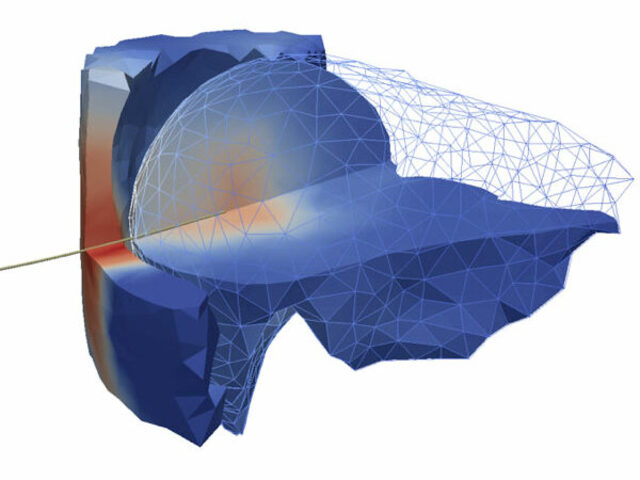
Making patient-specific numerical simulation easier in biomechanics, and so opening the way to digital twins. The project builds on φ-FEM, an immersed boundary method that simplifies the construction of finite element meshes for complex geometries: it requires only that the geometry be described by a level-set function, which can be computed directly from the segmentation of medical images.
The approach reaches optimal accuracy for any type of element — comparable to that of geometrically conforming finite elements — while remaining algorithmically simple. Unlike XFEM and CutFEM, φ-FEM introduces no integration over cut elements, and so avoids the construction of local submeshes entirely.
The aim is to demonstrate its applicability to multiphysics problems in large deformations and to integrate the results into Feel++, the open-source C++ finite element library. The method is adapted to the biomechanical setting on regular hexahedral meshes, so as to avoid numerical locking, then extended to situations specific to biomechanics: material heterogeneity, topology changes. In the longer term, combining it with neural networks aims at the real-time digital twin — the level-set makes it possible to feed the geometry into the network, and the speed of φ-FEM accelerates training.
Participants
- Michel Duprez (Inria senior researcher) — design and numerical analysis of finite element schemes, immersed boundary methods; co-inventor of φ-FEM.
- Stéphane Cotin (Inria senior researcher) — computational biomechanics; founder of the SOFA consortium.
Both in the MLMS team of the ICube laboratory.